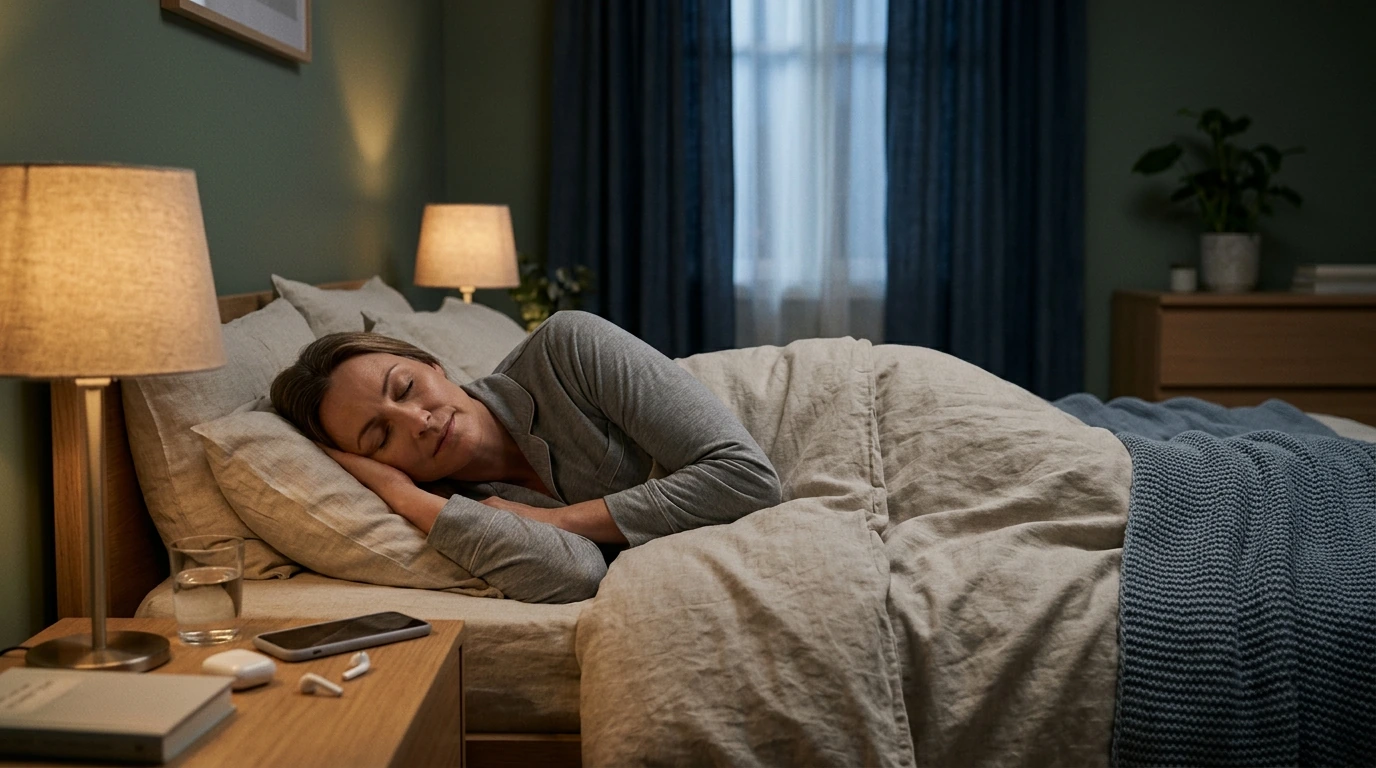
Restless nights often come from an overworked nervous system, a busy mind, and inconsistent wind-down habits. A short, structured audio routine can help create a repeatable path from “wired” to “sleepy” by pairing calming guidance with relaxation techniques that become easier with practice. The goal isn’t to force sleep, but to make the conditions for sleep more likely—night after night.
When sleep won’t come, it can feel like a personal failure. In reality, sleep difficulty is often a predictable outcome of a few common patterns:
For a deeper look at evidence-based insomnia support (including CBT-I), see the National Heart, Lung, and Blood Institute overview: Cognitive Behavioral Therapy for Insomnia (CBT-I) — NHLBI.
A guided routine gives your brain fewer chances to negotiate. Instead of deciding what to do next, you follow a sequence that’s already mapped out.
For practical baseline habits that make any routine more effective, the NIH has a helpful guide: Healthy Sleep Habits — National Institutes of Health (NINDS).
Sleep Reset is designed as a 7-day sequence of guided audio sessions focused on sleep meditation, deep relaxation, and insomnia relief. It’s especially useful for people who feel mentally “on” at night or who benefit from a structured wind-down.
| Feature | What it helps with | How to use |
|---|---|---|
| 7-day guided sequence | Builds a repeatable wind-down habit | Play one session nightly |
| Relaxation-focused guidance | Eases muscle tension and racing thoughts | Follow prompts without forcing sleep |
| Bedtime-friendly pacing | Encourages a steady downshift into drowsiness | Use in a dark, quiet environment |
| Routine-based approach | Reduces decision fatigue at night | Keep start time consistent when possible |
If you want a simple, structured starting point, use Sleep Reset: Guided Audio Course for Restful Nights – 7-Day Sleep Meditation, Deep Relaxation, Insomnia Relief in bed at roughly the same time each night. Headphones are optional; a quiet, dim room helps.
Think of the week as practice rather than performance. Your job is consistency; the routine does the heavy lifting.
Guided audio works best when the room supports “downshift.” Small changes can make the session feel more effective without adding effort.
To make light changes easier to follow night after night, consider the Room Lighting Plan Checklist as a simple reference for dialing in brightness and timing.
If you’d like more options for relaxation techniques that complement guided audio, Mayo Clinic summarizes several approaches here: Sleep and Relaxation Techniques — Mayo Clinic.
Some people feel calmer the first night, but lasting improvements usually come from repeating the routine consistently for at least a week. The most reliable early sign of progress is reduced arousal—less tension, fewer spiraling thoughts—even if sleep timing changes more gradually.
Lower the volume, try a speaker instead of headphones (or vice versa), and focus on following the relaxing cues rather than “listening hard.” Even if you stay awake longer, calming your body is still progress that can make sleep more likely later.
Yes—repeating your favorite sessions can reinforce the association between the routine and sleep. Keeping the same pre-sleep setup helps, and a session can also be useful during middle-of-the-night wake-ups when you want a low-stimulation way to settle.












Leave a comment