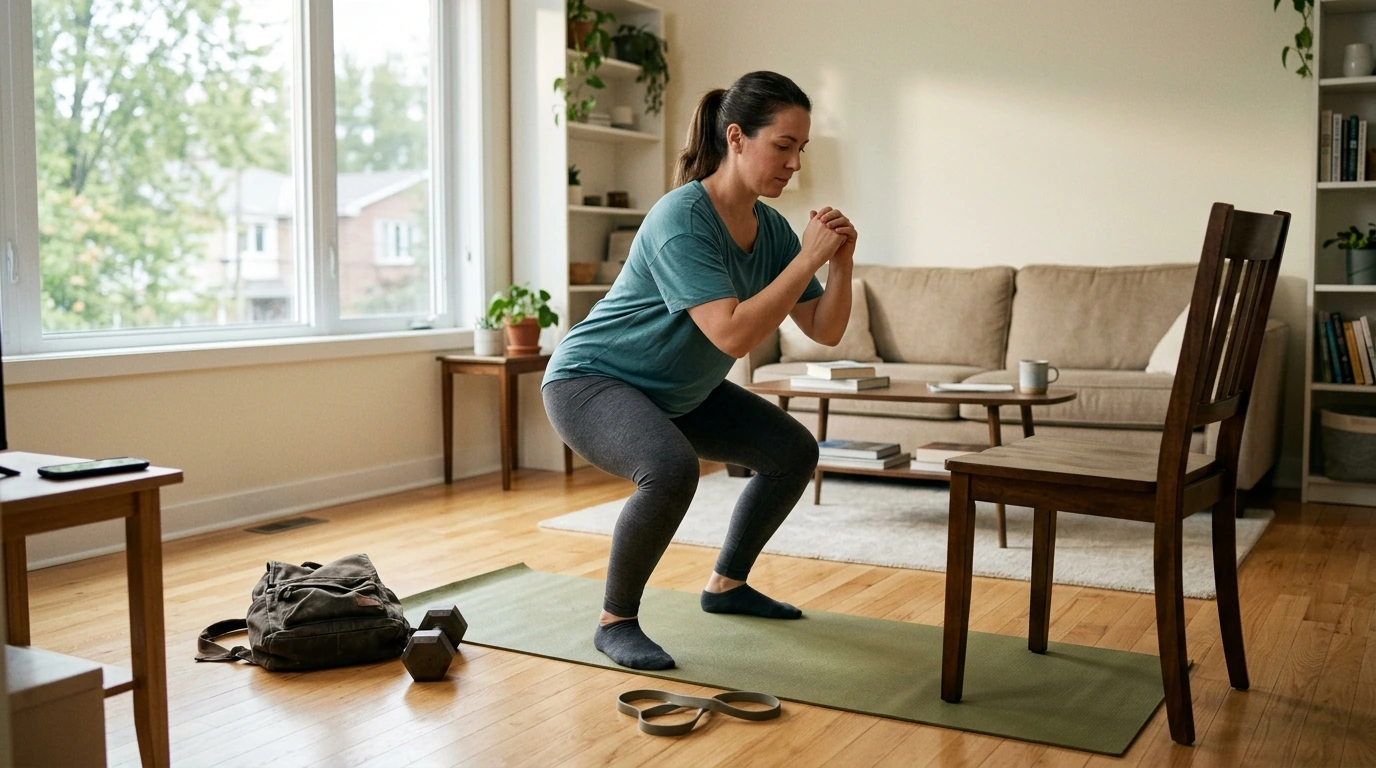
A consistent home routine works best when it’s simple, repeatable, and scaled to the space and equipment available. A 4-week plan is long enough to build momentum, practice key movement patterns, and feel measurable progress—without needing a full gym or hours of free time. Below is a practical way to think about how a month of training typically progresses, what “minimal equipment” can look like in real homes, and how to keep daily workouts and stretches realistic on busy schedules.
A well-built home plan isn’t just random circuits. Over four weeks, the goal is usually to improve multiple “pillars” of fitness with repeatable sessions that don’t beat you up.
If you want a general benchmark for weekly activity targets, the CDC’s adult guidelines are a useful reference point for balancing strength and cardio across the week.
CDC — How Much Physical Activity Do Adults Need?
Minimal equipment doesn’t mean “no plan” or “no progression.” It means choosing tools that are easy to store and using household items strategically.
| Movement need | If you have equipment | If you have none |
|---|---|---|
| Added resistance | Dumbbell/kettlebell | Backpack loaded with books or water bottles |
| Pulling/rows | Resistance band + anchor | Towel row isometrics (brace feet, pull and hold) |
| Step-up platform | Plyo box/bench | Sturdy chair or stair step |
| Core work | Ab wheel or sliders | Towel on smooth floor for hamstring curls/slides |
| Timing | Interval timer | Phone stopwatch with set rest periods |
Most home sessions work best with a simple template. You get a predictable flow, and progression becomes easy to track.
For evidence-based resistance training fundamentals (frequency, progression, and safety), ACSM’s overview is a solid starting point.
American College of Sports Medicine (ACSM) — Resistance Training for Health and Fitness
A “good week” at home is one you can repeat. The rhythm below keeps full-body strength as the backbone, adds optional conditioning, and gives mobility enough attention to keep joints feeling good.
| Day | Focus | What it looks like |
|---|---|---|
| Day 1 | Full-body strength A | Squat + push + core circuit, moderate rest |
| Day 2 | Mobility + light cardio | 20–30 min walk + daily stretch sequence |
| Day 3 | Full-body strength B | Hinge + pull + core, plus optional finisher |
| Day 4 | Recovery / technique | Low-impact movement + longer mobility focus |
| Day 5 | Full-body strength C | Mixed full-body circuit, slightly higher pace |
| Day 6 | Conditioning (optional) | Intervals: low-impact or moderate intensity |
| Day 7 | Rest + stretch | Short walk and gentle stretching |
NIH MedlinePlus — Exercise and Physical Fitness
Most sessions land around 20–40 minutes including a warm-up and a short stretch. On busy days, a 10–15 minute circuit (2–3 rounds) still maintains momentum and keeps the habit intact.
Yes—progress comes from bodyweight variations, slower tempo, unilateral moves (single-leg or single-arm emphasis), and household loading like a backpack with books or water jugs. You can also increase challenge by adding reps, sets, or reducing rest.
Use a dynamic warm-up before training to prepare joints and increase body temperature. Save longer static holds for after the workout or later in the day, aiming for consistency rather than perfect timing.













Leave a comment